In the rapidly shifting landscape of web scraping, social media management, and automated network intelligence, a silent but fierce battle is occurring at the connection layer. As target platforms deploy highly advanced anti-bot systems like Cloudflare, Akamai, and Datadome, traditional cloud datacenter proxies are flagged and blocked almost instantly. Bypassing these barriers requires developers to route automated requests through clean, domestic consumer IP addresses. For automated integration, explore our dedicated mobile proxies.
Two premium proxy classes dominate the modern developer stack: Mobile Proxies and ISP Proxies. Each claims to offer the ultimate combination of trust, performance, and reliability. However, they operate on completely different network structures, routing protocols, and pricing models. In this guide, we will conduct an in-depth comparison of mobile proxies versus ISP proxies, analyze their operational parameters, and determine which proxy type works best for different corporate use cases.
What is a Mobile Proxy?
A mobile proxy is an IP address provided by a cellular mobile carrier (such as Verizon, T-Mobile, Vodafone, or AT&T) and assigned to an active mobile device (such as a smartphone or cellular modem) connected to a 3G, 4G, or 5G cell tower. These proxies route your outbound web traffic through cellular towers, making them appear as a real consumer browsing the web from a mobile device.
The secret weapon behind mobile proxy security is Carrier-Grade Network Address Translation (CGNAT). Because there is a global shortage of public IPv4 addresses relative to the billions of mobile devices in use, cellular networks do not assign a unique public IP to each phone. Instead, a cellular tower routes thousands of active mobile devices through a single public IPv4 address simultaneously.
From an anti-bot system's perspective, this CGNAT structure is crucial. If Instagram, Google, or TikTok blocks a mobile IP address due to suspicious automated request volumes, the platform risks blocking thousands of real, innocent mobile users sharing that same cellular tower IP. To avoid locking out actual customers, target platforms apply extremely lenient rate limits and near-zero block weights to cellular ASN registries.
What is an ISP Proxy?
An ISP proxy (often referred to as a static residential proxy) is an IP address hosted directly inside a high-speed commercial datacenter but registered under a legitimate consumer broadband Internet Service Provider (like Comcast, AT&T, Charter Spectrum, or BT).
This hybrid network architecture is highly effective. By hosting the proxy lines on dedicated datacenter server hardware, ISP proxies achieve lightning-fast connection speeds (often sub-15ms pings) and benefit from 100% stable, persistent connection channels. At the same time, because the IP is registered under a consumer broadband provider's Autonomous System Number (ASN), target firewalls index the connection as a genuine home network router rather than a server.
Unlike standard rotating residential proxies that route traffic through home user devices (which can go offline or disconnect randomly), static ISP proxy endpoints proxies are highly reliable. They remain online 24/7, providing stable, permanent sessions with unlimited bandwidth billing models.
Do Mobile Proxies Work Better Than ISP Proxies?
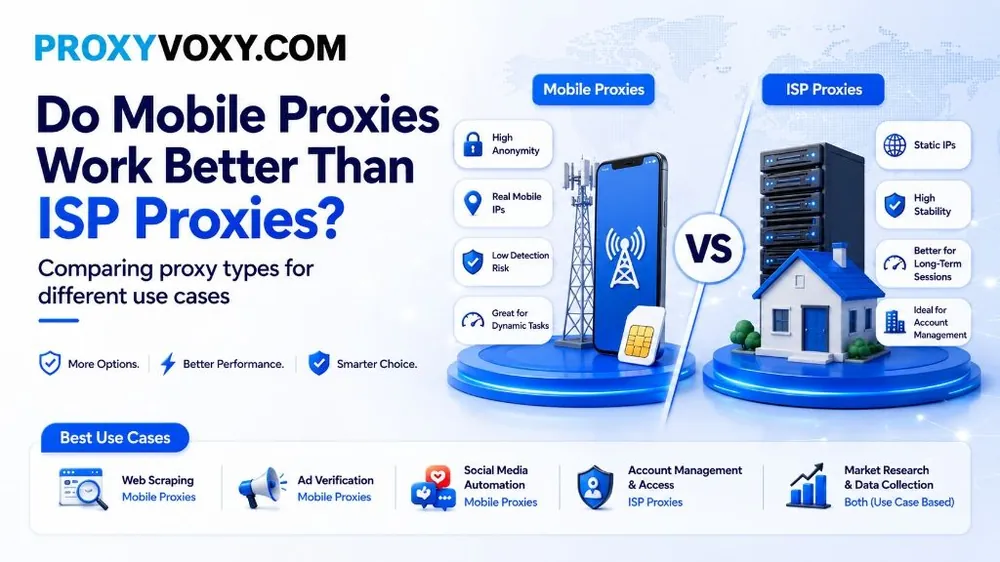
Yes, mobile proxies work better than ISP proxies for tasks that involve high-security mobile application scraping, social media account creation, and bypassing aggressive, real-time behavioral filters. However, ISP proxies work better than mobile proxies for tasks that require high-speed performance, session persistence, and large bandwidth consumption, such as retail sneaker copping, high-frequency web crawling, and e-commerce price auditing.
The choice is not about finding a single "best" proxy type, but rather aligning your project's technical specifications and budget constraints with the proper IP reputation class. Mobile proxies provide the absolute highest trust score due to CGNAT pooling but carry high metered pricing and slower speeds. ISP proxies offer the optimal balance of datacenter speed, stable sessions, and flat-rate pricing while maintaining a highly reliable residential trust score.
Mobile vs. ISP Proxies: The Performance Comparison
To help system architects evaluate the structural differences between these two proxy classes, the following matrix compares cost, latency, pool depth, and stability:
| Operational Metric | Mobile Proxies (4G/5G) | Static ISP Proxies |
|---|---|---|
| IP Allocation Model | Shared CGNAT (thousands of devices share one public IP) | Dedicated static IP (one IP leased per user account) |
| Anti-Bot Trust Score | Highest (Near-zero block risk due to shared CGNAT) | High (Authentic domestic broadband provider ASN) |
| Connection Speed & Latency | Slower (34ms - 50ms due to cell tower transit hops) | Ultra-Fast (Sub-15ms pings on datacenter fiber) |
| Session Uptime & Stability | Dynamic (IP cycles frequently due to tower handovers) | 100% Constant (Permanent connection stability) |
| Billing Structure | Metered/Usage-based (high cost per GB consumed) | Flat-rate (billed per IP with unlimited bandwidth) |
Comparing Proxy Types for Different Use Cases
Social Media Automation & Anti-Detection
Social networks (like Instagram, TikTok, Facebook, and LinkedIn) run extremely strict security scripts to detect automated multi-accounting.
- Why Mobile Proxies Excel: When managing mobile applications or creating new accounts, mobile proxies are highly recommended. Because mobile apps expect organic user traffic from cellular networks, routing requests through mobile carrier ASNs avoids triggering security check flags, keeping your social accounts fully active.
- Why ISP Proxies Excel: For desktop outreach campaigns or long-lived marketing profiles, static ISP proxies are the clear winner. LinkedIn and Facebook log session coordinates. If your IP address rotates dynamically between cities, it triggers "impossible travel" detection, causing suspensions. Binding each profile to a permanent static ISP IP maintains absolute session consistency.
Web Scraping & Data Extraction
Scraping modern, dynamic web pages requires a careful balance of block evasion and bandwidth budget control.
- Rotating Residential Proxies: The gold standard for high-volume list harvesting. By using ProxyVoxy's extensive pool of over 90 million homeowner IPs, developers can distribute millions of concurrent requests globally at a highly cost-effective metered rate, starting at just $2.00/GB.
- Static ISP Proxies: Best when scraping targets that require logging in (like seller directories or portal consoles), where changing your IP address mid-session would trigger security checks.
- Mobile Proxies: Highly effective at scraping targets with strict rate limits, but expensive for high-volume pipelines because cellular bandwidth is metered at higher rates.
Retail Drops & Sneaker Bots
Copping limited-release sneakers or high-demand tickets requires automated bots to complete payment checkouts in milliseconds.
- The Static ISP Advantage: In retail botting, connection speed determines success. Static ISP proxies are hosted on datacenter optical fiber, delivering sub-15ms connection latencies. Additionally, because the IP carries a legitimate Comcast or Verizon residential ASN, it bypasses checkout anti-bot guards seamlessly. The combination of speed and trust makes static ISP proxies the undisputed standard for sneaker botting.
Ad Verification & Fraud Prevention
Advertisers and compliance audits must verify programmatic ad placements without alerting fraud networks.
- The Mobile Proxy Advantage: Ad fraud systems and malicious publishers monitor incoming traffic. If they detect a scraper from a static broadband IP, they serve mock ads or redirect queries to look compliant. Mobile proxies represent the highest trust available because of the shared CGNAT architecture. Routing verification crawls through mobile carrier IPs ensures you see exactly what a real smartphone user sees, detecting hidden redirects.
Setting Up SOCKS5 Sockets for Mobile and ISP Proxies
To achieve maximum anonymity and connection efficiency, developer teams should route their proxy traffic over the SOCKS5 protocol rather than standard HTTP/HTTPS.
SOCKS5 operates at the transport layer of the network (Layer 5 of the OSI model), routing raw TCP or UDP data packages transparently without modifying headers. Unlike HTTP proxies, SOCKS5 does not inject identifying flags (like Via or X-Forwarded-For) that disclose your automated proxy setup to target firewalls. Furthermore, it supports remote DNS resolution, which prevents local DNS query leaks that could unmask your real scraper server IP.
Below is a production-grade Python script demonstrating how to configure advanced rotating SOCKS5 proxies using the robust requests library:
import requests

def run_socks5_scraper():
    # Configure ProxyVoxy SOCKS5 rotating residential proxy gateway
    # Remote DNS resolution is enabled using the 'socks5h://' protocol prefix
    proxy_user = "your_proxyvoxy_username-zone-resi"
    proxy_pass = "your_secure_password"
    proxy_url = f"socks5h://{proxy_user}:{proxy_pass}@proxy.proxyvoxy.com:7777"

    proxies = {
        "http": proxy_url,
        "https": proxy_url
    }

    headers = {
        "User-Agent": "Mozilla/5.0 (Windows NT 10.0; Win64; x64) AppleWebKit/537.36 (KHTML, like Gecko) Chrome/120.0.0.0 Safari/537.36",
        "Accept": "text/html,application/xhtml+xml,application/xml;q=0.9,image/webp,*/*;q=0.8",
        "Accept-Language": "en-US,en;q=0.5",
        "Connection": "keep-alive"
    }

    target_url = "https://httpbin.org/ip"

    try:
        print("[Info] Initiating secure SOCKS5 proxy handshake...")
        response = requests.get(target_url, headers=headers, proxies=proxies, timeout=12)

        if response.status_code == 200:
            print("[Success] Secure Connection Established!")
            print(f"[Info] Outbound Node IP: {response.json().get('origin')}")
        else:
            print(f"[Error] Handshake failed. Status Code: {response.status_code}")
    except Exception as e:
        print(f"[Connection Error] SOCKS5 proxy tunnel failed: {e}")

if __name__ == "__main__":
    run_socks5_scraper()
FAQ: Frequently Asked Questions
Can a website block a mobile proxy IP?
A website can block a mobile proxy IP address, but it rarely does so permanently. Because cellular networks use Carrier-Grade NAT (CGNAT), thousands of legitimate smartphone users share the same public IP. Blocking a mobile IP permanently would lock out innocent consumers, damaging the website's traffic. Therefore, platforms apply very lenient rate rules to mobile IP ranges.
Which proxy type has the lowest latency?
Static ISP proxies have the lowest latency, typically delivering pings under 15ms. Because ISP proxies are hosted directly inside datacenters on high-speed fiber-optic lines, they avoid the cellular tower hops and wireless signal degradation that add latency to 4G/5G mobile connections.
Why are mobile proxies more expensive than residential or ISP proxies?
Mobile proxies are more expensive because running physical cellular hardware (modems, SIM cards) and purchasing cellular data plans from telcos carries a high operational cost. While ProxyVoxy offers wholesale residential proxies starting at just $2.00/GB, mobile carrier data is billed at a premium due to these mobile network overheads.
Can I run multiple accounts on a single static ISP proxy?
No, you should run only one social media or seller account per static ISP proxy. Social networks track account correlation. If multiple accounts log in from the exact same static residential IP, the platform will group them together, meaning a ban or flag on one profile will instantly trigger suspensions across all linked accounts.