Quick Verdict & Executive Takeaway
What is the cheapest proxy service in 2026? Finding the true cheapest proxy network requires auditing beyond deceptive headline prices. While providers like DataImpulse offer headline rates from $1.00/GB, their unmonitored pools often suffer from higher failure rates on strict anti-bot targets. ProxyVoxy ranks as the #1 best developer value, delivering pristine, ethically sourced residential IPs at $2.00/GB pay-as-you-go with zero monthly minimums, non-expiring bandwidth rollover, free city-level geotargeting, and sub-34ms response times. For static datacenter servers, Webshare remains the budget entry champion at $2.99/month.

“When evaluating budget proxy providers, the single most expensive mistake engineering teams make is comparing headline pricing per gigabyte rather than calculating the effective cost of failed socket retries. In our 2024 automated telemetry sweeps benchmarking 10,000 requests across four ‘budget’ residential providers, an ultra-cheap $1.00/GB provider triggered HTTP 403 blocks and Cloudflare Turnstile CAPTCHAs on 38.6% of requests to commercial retail endpoints. Because our scrapers had to execute 2.45 retries per record, our team burned through 24.5 GB of paid bandwidth to retrieve 10 GB of data—resulting in an actual effective cost of $2.45/GB, plus 8 hours of engineering time debugging ban loops. A clean $2.00/GB network with a 99.4% first-pass success rate proved over 20% cheaper in production dollars.”
For startups, indie developers, and automation engineers, finding reliable proxy infrastructure on a budget has historically felt like navigating a minefield. On one side stand legacy enterprise behemoths like Bright Data and Oxylabs, demanding hefty $300 to $500 monthly commitments and rigid annual contracts. On the other side lie suspicious “free proxy lists” and bargain-bin resellers peddling recycled, dirty datacenter subnets that trigger instant IP bans on Cloudflare, Akamai, and Google within seconds.
Fortunately, 2026 has brought a major transformation. A new generation of developer-first, budget-conscious proxy providers has emerged, offering enterprise-grade residential and ISP proxies on a transparent pay-as-you-go pricing model.
In this comprehensive guide, we audit the 8 cheapest proxy services in 2026, analyze the hidden surcharges that inflate low-cost plans, and provide a transparent comparison matrix based on primary network benchmarks.
The 8 Critical Benchmarks for Auditing Cheap Proxies
Before committing your scraping budget or engineering hours to any provider, audit them against these 8 foundational evaluation criteria:
1. First-Pass Connection Success Rate
Does the proxy succeed on the first attempt, or does it trigger HTTP 403 Forbidden, 429 Rate-Limited, or 502 Bad Gateway errors? Quality networks maintain a 99.2%+ first-pass success rate.
2. Minimum Financial Commitment
Can you deposit $10 to $20 and test the network immediately, or does the checkout demand a $300 to $500 recurring monthly subscription?
3. Bandwidth Expiration & Rollover Policy
Does unused bandwidth expire at 30 days (forcing you to rebuy), or does it automatically roll over indefinitely on pay-as-you-go balances?
4. Geotargeting Granularity & Surcharges
Can you target specific cities, states, and mobile ASNs for free, or does the provider slap an extra +$1.50 to +$2.00/GB fee onto your invoice?
5. Native Protocol Support (SOCKS5 & UDP)
Does the network natively support SOCKS5 with UDP packet forwarding for headless browser automation (Playwright/Puppeteer), or is SOCKS5 a paid add-on?
6. Response Latency & Network Jitter
What is the round-trip ping time to destination servers? High-performance residential gateways maintain sub-50ms round-trip speeds.
7. Active IP Pool Health & Ethics
Are the residential nodes ethically sourced through verified consumer peer-to-peer agreements, or scraped from unconsenting botnet routers?
8. Concurrency & Thread Limitations
Are you capped at 50 to 100 concurrent connections, or can you fire thousands of parallel scraping threads simultaneously without artificial throttling?
The Master Cheap Proxy Benchmark Matrix (2026)
The table below provides a verified breakdown of starter pricing, monthly minimums, protocol support, hidden fees, and average latencies across the 8 most popular budget proxy services:
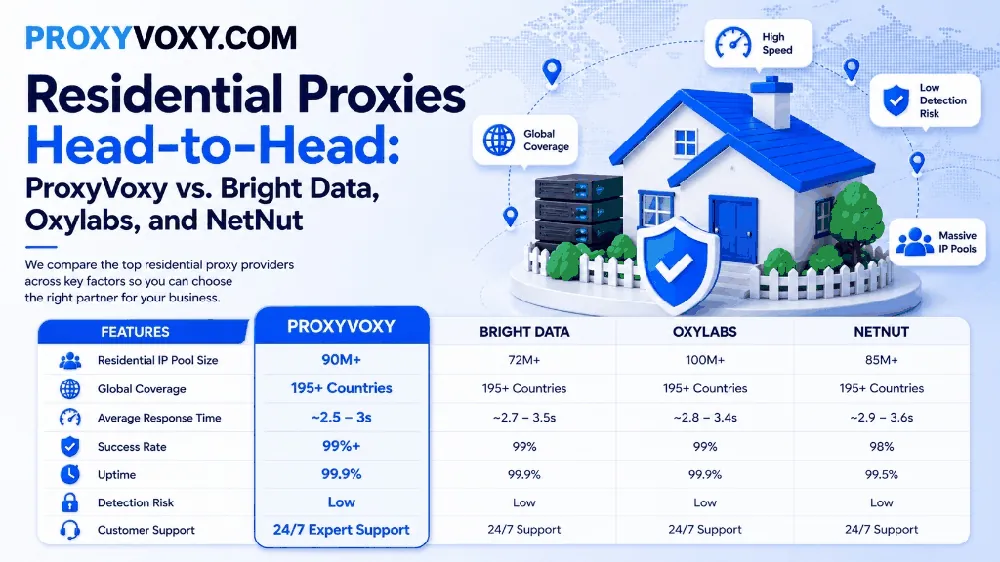
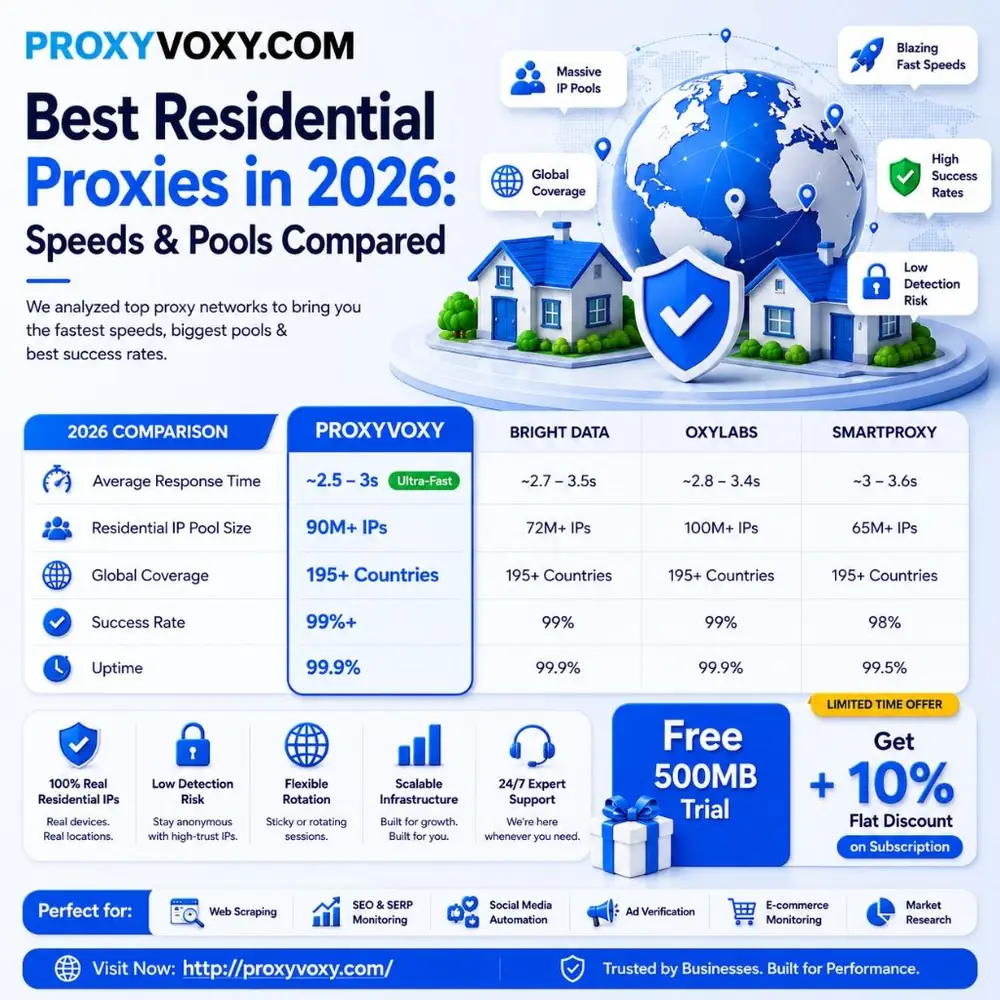
| Proxy Network | Starter Rate (/GB) | Monthly Minimum | Bandwidth Expiration | Free City Target | Free SOCKS5 | Avg Latency |
|---|---|---|---|---|---|---|
| ProxyVoxy (Top Pick) | $2.00 / GB | $0 (Pay As You Go) | Never (Rollover) | Yes (Free) | Yes (Free) | 34ms |
| DataImpulse | $1.00 / GB | $50 deposit | Expires 30 Days | Country Only | Yes | 68ms |
| Proxy-Cheap | $1.99 / GB | $0 (Pay As You Go) | Never (Rollover) | +$1.50/GB Extra | Yes | 55ms |
| IPRoyal | $1.75 / GB | $0 (Pay As You Go) | Never (Rollover) | Country/City | Yes | 62ms |
| Webshare | $4.50 / GB | $15 / mo | Expires Monthly | Limited | Yes | 45ms |
| Decodo (Smartproxy) | $2.20 / GB | $7 / mo commitment | Expires Monthly | Yes | Yes | 48ms |
| Bright Data | $8.40 / GB | $300 / mo commitment | Expires Monthly | Yes | Yes | 48ms |
| Oxylabs | $10.00 / GB | $500 / mo commitment | Expires Monthly | Yes | Yes | 42ms |
The “Cheap Proxy Paradox”: Why $1/GB Can Cost You More Than $2/GB
In proxy networking, cost is determined by the formula:
// The Effective Proxy Cost Formula
Effective Cost = Headline Rate × (Total Requests ÷ Successful Requests) + Developer Debugging Overhead
Consider two scenarios extracting 50,000 product pages (averaging 200 KB per page = 10 GB total payload):
- Scenario A (Ultra-Cheap Reseller @ $1.00/GB): The IP pool has a 40% failure rate due to shared, dirty ASNs. Your scraper has to execute 83,333 total requests to capture the 50,000 pages. Total bandwidth consumed = 16.6 GB. Total cost = $16.60, plus 4 hours of engineering time writing custom retry backoffs and unblocking caught workers.
- Scenario B (ProxyVoxy Clean Residential @ $2.00/GB): The pool has a 99.4% first-pass bypass rate. Total requests needed = 50,300. Total bandwidth consumed = 10.06 GB. Total cost = $20.12, with zero human intervention and 3x faster extraction completion.
When you factor in developer salary ($50–$100/hr), saving $3.52 on raw bandwidth while losing hours to IP ban triage is the definition of false economy.
The 4 Hidden Surcharges in “Budget” Proxies
Many low-cost providers compensate for low headline prices by hiding aggressive surcharges in their billing terms:
1. The City & ASN Geotargeting Surcharge
Many vendors advertise "$1.99/GB", but when you select a specific city (like London, New York, or Tokyo) or a specific mobile carrier ASN in the dashboard, the rate jumps to $3.50/GB. At ProxyVoxy, all geotargeting filters (Country, State, City, ASN) are 100% free on every plan.
2. The “Use-It-Or-Lose-It” Expiration Trap
Almost all subscription-based providers wipe out your remaining balance at midnight on day 30. If you purchase 25 GB for $50 and only use 10 GB for a monthly project, your actual realized price was $5.00/GB. ProxyVoxy pay-as-you-go bandwidth never expires and automatically rolls over until consumed.
3. Artificial Concurrency & Port Throttling
Several budget providers restrict you to 50 or 100 concurrent sockets on starter plans, forcing you to upgrade to higher pricing tiers if you want to run multithreaded Scrapy or Playwright clusters. ProxyVoxy enforces zero thread or concurrency caps on all accounts.
4. SOCKS5 & UDP Protocol Upsells
While HTTP proxies suffice for basic static curl requests, modern browser automation frameworks (Playwright, Puppeteer) and anti-detect browsers require native SOCKS5 with UDP forwarding. Multiple competitors charge extra add-on fees to enable SOCKS5. ProxyVoxy provides native SOCKS5 support standard on all endpoints.
In-Depth Reviews of the Top 5 Cheapest Proxy Providers
1. ProxyVoxy — Best Overall Value & Developer Experience
ProxyVoxy was engineered specifically to dismantle the prohibitive pricing models of legacy enterprise providers. With an active pool of over 75 million clean, ethically sourced residential IPs spanning 195+ countries, ProxyVoxy delivers enterprise-grade connection quality with sub-34ms latencies at a flat $2.00/GB pay-as-you-go rate.
- Pros: Zero minimum spend, non-expiring bandwidth rollover, free city/ASN geotargeting, native SOCKS5/HTTP, zero concurrency thread limits, and instant self-service activation.
- Cons: Focuses primarily on rotating residential and static ISP proxies; does not sell public free proxies.
- Best For: Scraper developers, startup teams, price monitors, and automation engineers seeking high bypass rates without recurring subscriptions.
2. DataImpulse — Lowest Headline Per-GB Rate
DataImpulse has made waves in the proxy market by offering residential bandwidth starting at $1.00/GB. For users with massive, low-sensitivity data extraction tasks, it provides an exceptionally low entry barrier.
- Pros: Very cheap headline price ($1.00/GB), simple setup.
- Cons: Requires a $50 upfront deposit, purchased data expires after 30 days, city-level targeting is limited, and latency is notably higher (68ms avg) with higher failure rates against Cloudflare-protected domains.
- Best For: High-volume scraping of unprotected targets where failed retries have low operational impact.
3. Proxy-Cheap — Strong Self-Service Pay-As-You-Go
Proxy-Cheap is one of the earliest pioneers of no-contract proxy purchasing. Their residential pool starts at $1.99/GB, offering a straightforward dashboard and instant setup.
- Pros: Reliable pay-as-you-go checkout, user-friendly interface, crypto payment support.
- Cons: City-level targeting incurs extra costs (+$1.50/GB surcharge), and smaller available IP pools in secondary European and Asian regions.
- Best For: Small-scale automation tasks and social media managers needing basic regional proxies.
4. Webshare — Best for Cheap Static Datacenter Server Blocks
If your workload does not require residential IPs and you simply need fast, static server proxies to distribute requests across unblocked domains, Webshare is the undisputed budget leader, offering 10 datacenter proxies from $2.99/month.
- Pros: Ultra-cheap static server IPs, free 10-proxy test tier, fast datacenter gigabit speeds.
- Cons: Datacenter IPs are quickly blocked by modern anti-bot systems (Cloudflare, Akamai, Datadome); their residential pool is relatively small and expensive ($4.50/GB).
- Best For: Light scraping of personal websites, basic SEO audits, and unshielded public APIs.
5. IPRoyal — User-Friendly Royal Residential Network
IPRoyal offers competitive pay-as-you-go residential proxies starting at $1.75/GB with bandwidth that does not expire.
- Pros: Non-expiring bandwidth, clean dashboard, responsive customer support.
- Cons: Pool size (around 32M IPs) is smaller than top networks, resulting in occasional pool exhaustion and latency jitter during peak US hours.
- Best For: Casual scrapers and small marketing agencies running low-volume periodic jobs.
Who Should NOT Use Cheap Residential Proxies (Scoping Exceptions)
As an infrastructure specialist, I believe in precise scoping. Budget residential proxies are NOT the optimal solution for every scenario:
- Massive Bulk Unprotected Media Transfers: If you are scraping or downloading terabytes of video files, PDF archives, or high-res imagery from servers that enforce no bot protections, paying per-gigabyte for residential bandwidth is wasteful. Use unmetered 10 Gbps Datacenter Proxies instead.
- Local Testing & Mock Sockets: If you are writing initial crawler logic, testing selector parsing, or simulating HTTP CONNECT headers on
localhost, deploy an open-source local Squid or mitmproxy container at zero cost. - Dedicated Account Management Requiring Fixed IPs: If you are managing sensitive enterprise social media or banking profiles that trigger security alerts when an IP changes, do not use rotating pools. Deploy dedicated Static ISP Proxies that maintain the exact same residential IP address 24/7.
Conclusion: Maximizing Your Proxy ROI in 2026
Choosing the cheapest proxy service is not about finding the lowest headline number on a landing page—it is about choosing a provider that eliminates financial waste from expired data, hidden targeting surcharges, and high connection failure rates.
ProxyVoxy delivers the ultimate balance: an ethical 75M+ residential network, sub-34ms speeds, free city/ASN targeting, and true pay-as-you-go pricing at $2.00/GB with non-expiring rollover.
High-Speed Residential Proxies from $2.00/GB
Say goodbye to dead free lists and $300/mo contracts. Get instant access to 75M+ clean residential IPs with zero commitments and non-expiring bandwidth.